


Low testosterone symptoms affect far more men than most expect, and many go unrecognized for years. When serum testosterone falls below clinical thresholds, the pattern is consistent: persistent fatigue, reduced libido, muscle loss, mood changes, and difficulty concentrating. If several of these signs match your experience, our hormone therapy programs connect you with a licensed provider who evaluates your labs and symptoms together. Diagnosis depends on both, not either one alone.
What are the first signs of low testosterone in men?
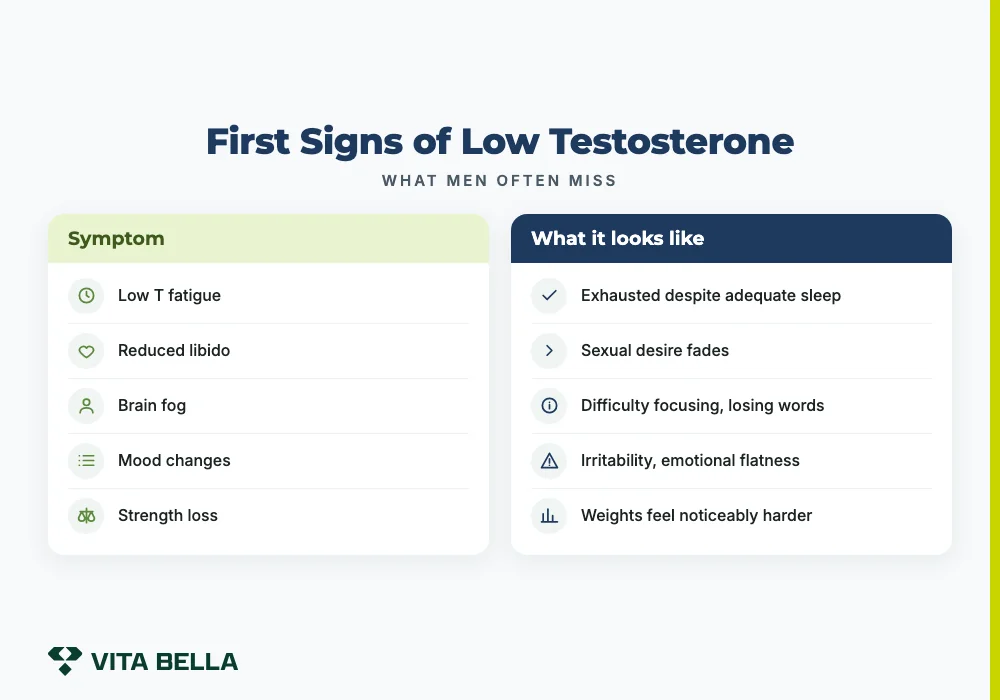
The earliest signs of low T tend to appear before most men expect them. Energy fades first, then motivation, then gym performance slips despite consistent effort. Each symptom feels explainable on its own. That is why testosterone deficiency in men often goes undetected for years.
| Symptom | What it looks like |
|---|---|
| Low T fatigue | Exhausted despite adequate sleep, dragging through mornings |
| Reduced libido | Sexual desire fades before performance declines |
| Brain fog | Slower recall, difficulty focusing, losing words mid-sentence |
| Mood changes | Irritability, emotional flatness, lower stress tolerance |
| Strength loss | Weights that once felt manageable now feel noticeably harder |
| Physical changes | Body fat gain around the abdomen, reduced muscle definition, less body hair |
Any single symptom might have another explanation. Together, these signs of low T point toward male hormone imbalance worth evaluating.
At what age does testosterone start to decline?
Testosterone decline after 30 is real, gradual, and measurable. A review in Frontiers in Endocrinology found that levels drop roughly 1% per year on average after that age. The decline is slow enough that most men normalize what they feel over time.
Population data suggest 6 to 12% of middle-aged and older men meet criteria for symptomatic hypogonadism. These are men whose levels have fallen far enough to produce clinical symptoms, not simply men at the lower end of the reference range. Most never find out until they actually get tested.
Can low testosterone cause depression and fatigue?
Yes. These are among the most consistent low testosterone symptoms documented in clinical research.
Low T fatigue goes beyond ordinary tiredness. It affects drive, motivation, and emotional bandwidth in ways that more sleep alone cannot fix. Research published in JAMA found associations between lower testosterone and reduced cognitive performance, particularly in executive function and verbal memory. Many men attribute these changes to stress or overwork. The hormonal connection goes unexamined.
Hypogonadism symptoms extend to mood as well. Apathy, reduced sense of purpose, and persistent irritability reflect testosterone's influence on dopamine activity and reward pathways. These are biological effects, not character traits.
What is the difference between low T and normal aging?
Testosterone decline after 30 is a normal physiological process. Hypogonadism is a clinical condition where levels fall below the threshold at which symptoms emerge and health risks compound.
The distinction matters for treatment. A 2024 Frontiers in Endocrinology review documents elevated risks of osteoporosis, central fat accumulation, insulin resistance, and dyslipidemia in men with confirmed hypogonadism. A 2025 NEJM review adds that observational data consistently link hypogonadism to worse cardiovascular profiles. These outcomes go beyond normal aging. Ignoring low testosterone symptoms is not a neutral choice.
How is low testosterone diagnosed by a doctor?
Diagnosis requires two separate morning blood draws on different days, each confirming total testosterone below approximately 300 ng/dL alongside matching symptoms. A single draw is not enough. Levels fluctuate between mornings and between days, which is why AAFP clinical guidelines specify the two-sample standard.
A full panel typically includes total testosterone, free testosterone, LH, FSH, estradiol, hematocrit, lipid panel, and PSA. If your total reads within range but something still feels off, what the full hormone panel reveals beyond a single number may explain the gap. A 2026 joint position statement on hypogonadism care (Hohl et al.) confirmed that symptom evaluation must accompany lab results, not replace them.
Long-term risks of untreated testosterone deficiency
Untreated male hormone imbalance compounds over time. Bone density loss, elevated fracture risk, central fat accumulation, and worsening insulin sensitivity all follow from sustained testosterone deficiency, as documented in the Frontiers in Endocrinology review. The cardiovascular relationship is complex, as the 2025 NEJM review notes, but consistent observational data link hypogonadism to poorer risk profiles. Waiting carries costs most men underestimate.
TRT for men: what treatment actually involves
TRT for men, when medically supervised, returns serum testosterone to the physiological range. A 2025 NEJM review found meaningful improvements in sexual desire, muscle strength, mood, and bone density within 3 to 6 months of consistent therapy. A licensed provider determines the dose after labs and adjusts based on how your levels, hematocrit, and estradiol respond.
Lifestyle changes amplify the benefit. Resistance training and quality sleep both support natural testosterone production alongside medical therapy. For men evaluating all their options, how TRT compares on energy, muscle, and libido outcomes is worth reading before any protocol decision.
Ready to find out where your levels stand?
Symptoms point to a possibility. Lab results give you certainty. At Vita Bella, every evaluation starts with a provider review and confirmed bloodwork, not a guess. Get Started to take the 60-second intake and connect with a licensed provider who reviews your full picture.
FAQ
What are the most common low testosterone symptoms?
Persistent fatigue, reduced libido, brain fog, mood changes, and muscle loss are the most frequently reported signs of low T. They appear gradually and overlap with stress or aging, which is why many men with testosterone deficiency go undiagnosed for years.
Can low testosterone cause depression and fatigue?
Yes. Hypogonadism symptoms include both. Low T affects dopamine pathways tied to motivation and mood, and research in JAMA found associations with reduced cognitive performance. Treating confirmed testosterone deficiency often improves energy and emotional resilience within months.
How is testosterone deficiency diagnosed?
A provider orders morning blood draws on two separate days, measuring total and free testosterone alongside LH, FSH, estradiol, and other markers. A diagnosis of hypogonadism requires below-threshold lab results combined with symptoms consistent with testosterone deficiency men typically report.
Is testosterone decline after 30 the same as hypogonadism?
No. Testosterone naturally drops roughly 1% per year after age 30, which is normal physiology. Hypogonadism occurs when levels fall below clinical thresholds and symptoms emerge, and that distinction determines whether treatment is appropriate.
Sources
- Bhasin S et al. (2025). Testosterone treatment in middle-aged and older men with hypogonadism. New England Journal of Medicine. PubMed
- Munari EV. (2024). The complications of male hypogonadism: Is it just a matter of low testosterone? Frontiers in Endocrinology. PubMed
- Testosterone and cognitive performance (2023). JAMA. PubMed
- Heidelbaugh JJ et al. (2024). Testosterone replacement therapy for male hypogonadism. American Family Physician. PubMed
- Hohl A et al. (2026). Care of patients with male hypogonadism. International Brazilian Journal of Urology. PubMed
For educational purposes only. Not a substitute for medical advice, diagnosis, or treatment. Consult a licensed healthcare provider before making any changes. A licensed provider will determine if a prescription is appropriate after evaluation. Individual results vary. Compounded medications are not FDA-approved for safety, efficacy, or quality.