



IGF-1 LR3 dosage is not set by a chart. A licensed provider determines the appropriate igf-1 lr3 dosage after reviewing your labs, health history, and recovery goals, because this peptide exerts real effects on glucose metabolism, tissue growth, and cellular signaling. As a long-acting analog of human IGF-1 with a half life of 20 to 30 hours, it delivers sustained receptor activity that the native form cannot match. If you are exploring IGF-1 peptide therapy, understanding what shapes your igf-1 lr3 dosage is the right place to start.
IGF-1 LR3 half life and how it differs from native IGF-1
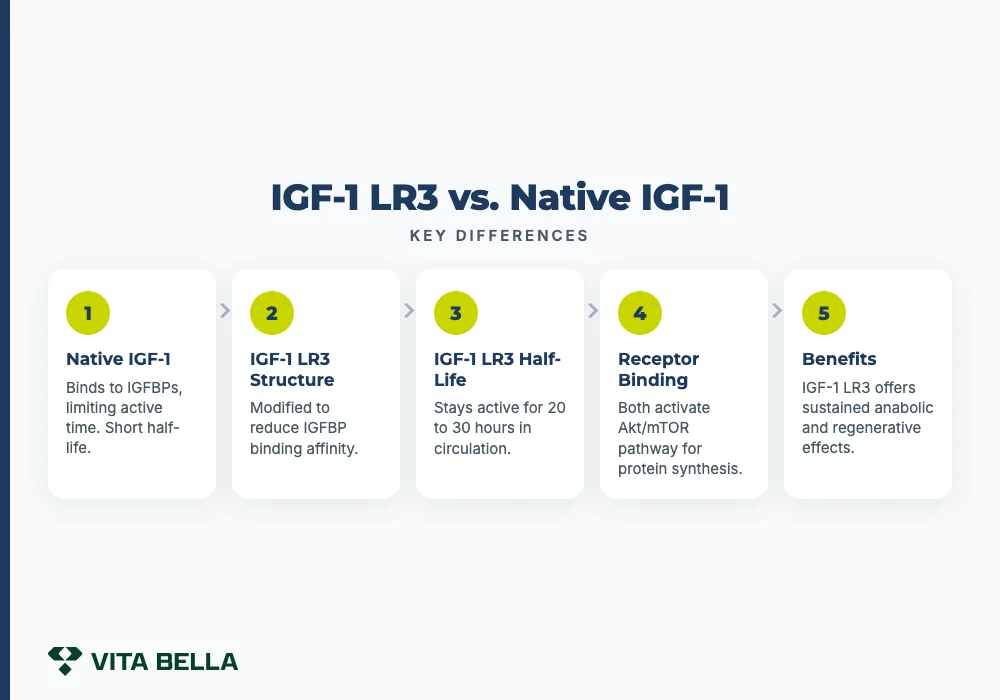
Native IGF-1 binds readily to IGF-binding proteins (IGFBPs), limiting its active time in circulation. IGF-1 LR3 bypasses that limitation through two structural changes: an arginine substitution at position 3 and a 13-amino-acid extension at the N-terminus. These modifications significantly reduce IGFBP binding affinity. Pharmacokinetic analysis of human plasma by Thomas et al. (2017) confirmed measurable bioavailability for over 24 hours following administration, establishing the igf-1 lr3 half life at 20 to 30 hours.
Once in active circulation, IGF-1 LR3 binds to IGF-1 receptors (IGF-1R) on muscle, bone, and connective tissue. That binding activates the Akt/mTOR pathway. A 2019 review in Frontiers in Nutrition by Barclay et al. found that IGF-1/Akt/mTOR signaling directly correlates with higher protein synthesis rates and improved muscle density, particularly when paired with resistance training and adequate protein intake. The extended igf-1 lr3 half life is the structural reason igf lr3 benefits exceed those of native IGF-1 in anabolic and regenerative applications.
Property | Native IGF-1 | IGF-1 LR3 |
|---|---|---|
IGFBP binding | High | Reduced |
Half life | Short (minutes to hours) | 20 to 30 hours |
Receptor engagement | Brief | Sustained |
Primary signaling pathway | Akt/mTOR | Akt/mTOR |
Documented applications | Endocrine signaling | Anabolic and regenerative protocols |
What is the optimal IGF-1 LR3 dosage for muscle growth?
There is no universally validated clinical dose for IGF-1 LR3 in humans. A licensed provider determines the appropriate igf-1 lr3 dosage after labs, using your baseline IGF-1 serum level, fasting glucose, lean mass, and concurrent therapies to build an individual protocol. Standardized charts strip out precisely the variables that make the difference between benefit and risk.
Thomas et al. (2017) confirmed that IGF-1 LR3 remains active in human plasma for over 24 hours per administration, meaning dosing frequency directly shapes receptor exposure and the desensitization risk. Providers weigh several factors when building a protocol:
Baseline serum IGF-1 establishes whether levels fall low, normal, or already elevated, which changes both the therapeutic rationale and the risk of overexposure.
Fasting glucose and insulin sensitivity determine how strongly IGF-1 LR3's glucose-uptake enhancement affects individual hypoglycemia risk.
Resistance training status affects receptor responsiveness; individuals engaged in regular strength training show greater IGF-1R sensitivity, which shifts the effective signal threshold.
Body composition goals differ between recovery-focused and hypertrophy-focused protocols, calling for different signaling intensity and duration.
Concurrent peptide or hormone therapies introduce compounding anabolic effects that require careful coordination to prevent excessive load.
The output is a personalized igf-1 lr3 dosage. The evaluation criteria above are more practically useful than any number found on a forum or in an unverified protocol guide.
How many weeks should an IGF-1 LR3 cycle last?
The igf-1 lr3 cycle length in research models runs four to six weeks, followed by a rest period before the next run. Continuous exposure progressively desensitizes IGF-1R, blunting the effects the therapy is designed to produce. Structured cycles give receptor populations time to reset. For a broader view of how this fits within a multi-compound protocol, the guide on managing peptide cycles over time covers timing and rest intervals across multiple compounds.
Follow-up labs at cycle end tell the provider whether the protocol produced the intended response in serum IGF-1, fasting glucose, and body composition markers. Adjustments happen between cycles, not mid-run. The igf-1 lr3 cycle length is a clinical parameter determined by biology, not a convention borrowed from anabolic steroid literature.
What a provider evaluates before prescribing IGF-1 LR3
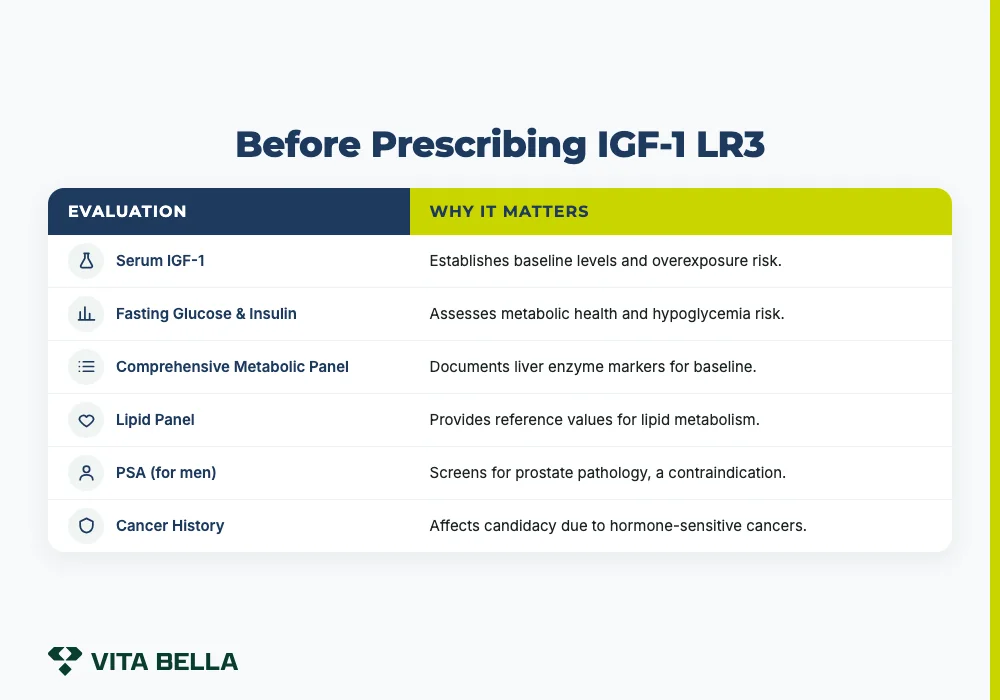
IGF-1 peptide therapy cannot be safely self-directed. The baseline evaluation is what separates a well-calibrated protocol from one that introduces avoidable risk. Most providers run a standard pre-treatment panel that includes:
Serum IGF-1 establishes your individual baseline and identifies whether levels are already at the upper end of normal, which changes both the therapeutic rationale and the overexposure risk.
Fasting glucose and insulin assess metabolic health and the hypoglycemia risk profile specific to the individual.
Comprehensive metabolic panel (CMP) captures liver enzyme markers that can shift during anabolic protocols and need documentation at baseline.
Lipid panel provides reference values since IGF-1 signaling interacts with lipid metabolism.
PSA for men screens for pre-existing prostate pathology, which represents a contraindication; a baseline value before starting also provides a clinical reference for ongoing monitoring.
Personal and family cancer history changes the risk assessment independently of lab values, since hormone-sensitive cancers in first-degree relatives affect the candidacy evaluation.
Follow-up labs at three to six months confirm that serum IGF-1, fasting glucose, and metabolic markers remain within a safe range. No competent provider runs IGF-1 LR3 without this monitoring infrastructure. It is the mechanism that keeps the igf-1 lr3 dosage calibrated to your actual biology.
What are the side effects of IGF-1 LR3?
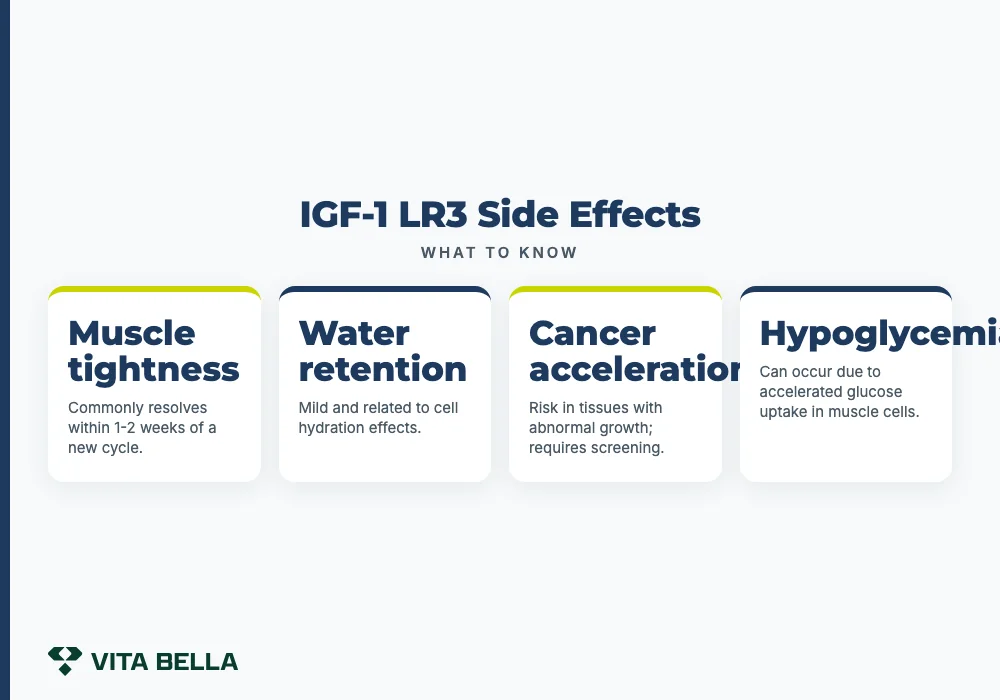
IGF-1 LR3 side effects fall into two categories: transient effects common during early adaptation and serious effects that emerge from inadequate screening or misuse. Supervised protocols manage both systematically.
Common, self-limiting effects include:
Muscle tightness and fullness arise from intracellular volume expansion during receptor activation and typically resolve within the first one to two weeks of a new cycle.
Mild water retention follows the cell hydration effects of IGF-1 signaling and correlates with circulating concentration relative to body weight.
Transient fatigue can occur during the metabolic adaptation phase before the mitochondrial biogenesis improvements documented by Miescher et al. (2023) become established.
Serious risks requiring pre-treatment evaluation include:
Cancer acceleration: IGF-1 broadly stimulates cell proliferation. In tissues already expressing abnormal growth, elevated IGF-1 can accelerate that process. Undiagnosed prostate, breast, or colorectal pathology represents a significant contraindication, which is why PSA screening and health history review come before any protocol approval.
Acromegaloid features: Chronic supraphysiologic IGF-1 over extended periods can produce changes resembling growth hormone excess, including alterations to facial features, hands, and feet. This appears in documented cases of misuse, not in supervised clinical protocols operating within physiologic ranges.
Receptor downregulation: Extended continuous exposure without cycling reduces IGF-1R sensitivity over time, diminishing therapeutic return.
Can IGF-1 LR3 cause hypoglycemia?
Yes. IGF-1 LR3 accelerates glucose uptake into muscle cells, lowering blood glucose. The effect is mild and manageable in properly supervised protocols through careful administration timing relative to meals. Risk rises significantly when administration occurs in a fasted state, in individuals with a history of low blood sugar, or when combined with insulin or other glucose-lowering agents. Providers use fasting glucose data from baseline labs to assess individual vulnerability before the first administration.
IGF-1 LR3 before and after: what the research shows
The igf-1 lr3 before and after picture depends on what you measure and when. Research in human-derived models documents changes across three domains: skeletal muscle, connective tissue, and metabolic efficiency.
Skeletal muscle: A 2004 study by Jacquemin et al. in Experimental Cell Research demonstrated that IGF-1 increases fusion index, myonuclei number, and myosin heavy chain content in human myotube models. These are direct markers of hypertrophy and cellular repair, not proxy measures. Barclay et al. (2019) further connected IGF-1/Akt/mTOR activation with higher measured protein synthesis rates specifically in response to resistance training and nutrient availability.
Connective tissue: A 2023 review by Miescher et al. in the International Journal of Molecular Sciences found that IGF-1 exposure elevated collagen I and III expression in human tendon cells, supporting faster matrix remodeling and tendon repair. The same review linked IGF-1 signaling to mitochondrial biogenesis and reduced post-exercise fatigue markers, which directly affects how quickly training capacity returns between sessions.
Muscle preservation: Kok and Barton (2021) in Seminars in Cell and Developmental Biology showed that IGF-1 regulates matrix metalloproteinases (MMPs) and cytokines during tissue remodeling, reducing fibrotic scarring. IGF-1 also suppresses ubiquitin-proteasome-driven protein degradation, preserving lean mass during recovery periods when training volume drops. That anti-atrophy effect is among the most practically significant igf-1 lr3 results for people managing injury or scheduled deloads.
For a broader look at how these mechanisms translate to practical outcomes, the complete IGF-1 LR3 guide covers growth and recovery applications in depth.
How long does IGF-1 LR3 take to show results?
Most igf-1 lr3 results documented in research models emerge within the four-to-six-week cycle window. Subjective improvements, reduced soreness and faster recovery between training sessions, often appear in the first two weeks. Objective changes in lean mass, collagen turnover markers, and serum IGF-1 levels require a full cycle plus lab confirmation to document meaningfully.
The rate at which changes become measurable depends on starting baseline. Someone beginning with low-normal IGF-1 serum levels typically sees a faster subjective response than someone starting near the upper end of normal, because the receptor environment is more sensitive to the incremental increase. Training consistency and protein intake amplify how clearly body composition changes register over the cycle.
Results compound across successive, well-monitored cycles rather than from a single run. Providers use inter-cycle lab data to adjust the next igf-1 lr3 dosage based on measured trajectory. That feedback loop is what distinguishes supervised igf-1 peptide therapy from unmonitored use.
Lifestyle factors that shape IGF-1 LR3 results
IGF-1 LR3 amplifies what your body is already doing. The quality of that amplification depends on three foundational inputs.
Protein intake supplies the substrate that Akt/mTOR activation converts into muscle protein. Barclay et al. (2019) note that protein synthesis rates respond to IGF-1/mTOR activation in proportion to available amino acids. Providers typically reference 1.6 to 2.0 grams of protein per kilogram of body weight as a baseline daily target, consistent with established sports nutrition evidence.
Resistance training increases IGF-1R responsiveness. More responsive receptors extract more benefit from the same circulating concentration of IGF-1 LR3. Skipping training during a cycle means the peptide signal reaches less receptive tissue.
Sleep quality matters because growth hormone pulsatility and endogenous IGF-1 production peak during deep sleep stages. Disrupted sleep degrades the hormonal environment that IGF-1 LR3 is designed to enhance, creating a ceiling on measurable results even when dosing and nutrition are well structured. Providers commonly assess sleep during the initial consultation for exactly this reason.
Start your IGF-1 LR3 dosage evaluation
Your labs and health history determine the right protocol. A licensed provider reviews both before recommending any igf-1 lr3 dosage and monitors your response throughout the cycle. Skip the evaluation, and the potential igf-1 lr3 results become unpredictable. Get Started with a short intake and connect with a provider who can assess your specific situation.
FAQ
Is IGF-1 LR3 effective for muscle growth?
Yes. Research in human myotube models shows IGF-1 LR3 activates the Akt/mTOR pathway, increasing protein synthesis, myonuclei count, and myosin heavy chain content, which are direct markers of hypertrophy. A 2019 review confirmed this signaling correlates with measurably higher protein synthesis rates in individuals engaged in resistance training.
How does IGF-1 LR3 differ from regular IGF-1?
IGF-1 LR3 carries structural modifications that reduce binding to IGF-binding proteins, extending its half life to 20 to 30 hours versus the shorter active window of native IGF-1. The result is sustained receptor engagement throughout the day rather than brief activity spikes.
Who should not use IGF-1 LR3?
Anyone with a personal or family history of hormone-sensitive cancers, active metabolic disease, or uncontrolled fasting glucose requires careful provider evaluation before considering IGF-1 LR3. Pre-treatment screening is the mechanism that keeps the therapy safe, not an administrative formality.
Can IGF-1 LR3 improve tendon and connective tissue recovery?
Yes. A 2023 review in the International Journal of Molecular Sciences found that IGF-1 exposure elevated collagen I and III expression in human tendon cells, supporting faster matrix remodeling and improved tissue repair. This connective tissue benefit compounds the muscular recovery effects across a structured cycle.
Sources
Thomas A et al. (2017). Determination of LongR3-IGF-I, R3-IGF-I, Des1-3 IGF-I and their metabolites in human plasma samples by means of LC-MS. Journal of Pharmaceutical and Biomedical Analysis. Link
Barclay RD et al. (2019). The role of the IGF-1 signaling cascade in muscle protein synthesis and anabolic resistance in aging skeletal muscle. Frontiers in Nutrition. PubMed
Jacquemin V et al. (2004). IGF-1 induces human myotube hypertrophy by increasing cell recruitment. Experimental Cell Research. PubMed
Miescher I et al. (2023). In vitro and in vivo effects of IGF-1 delivery strategies on tendon tissue repair: A review. International Journal of Molecular Sciences. Link
Kok HJ and Barton ER (2021). Actions and interactions of IGF-I and MMPs during muscle regeneration. Seminars in Cell and Developmental Biology. PubMed
For educational purposes only. Not a substitute for medical advice, diagnosis, or treatment. Consult a licensed healthcare provider before making any changes. A licensed provider will determine if a prescription is appropriate after evaluation. Individual results vary. Compounded medications are not FDA-approved for safety, efficacy, or quality.